Protect respiratory health with real-time monitoring of pollen, dust mites, mold spores, and other airborne allergens
Explore Details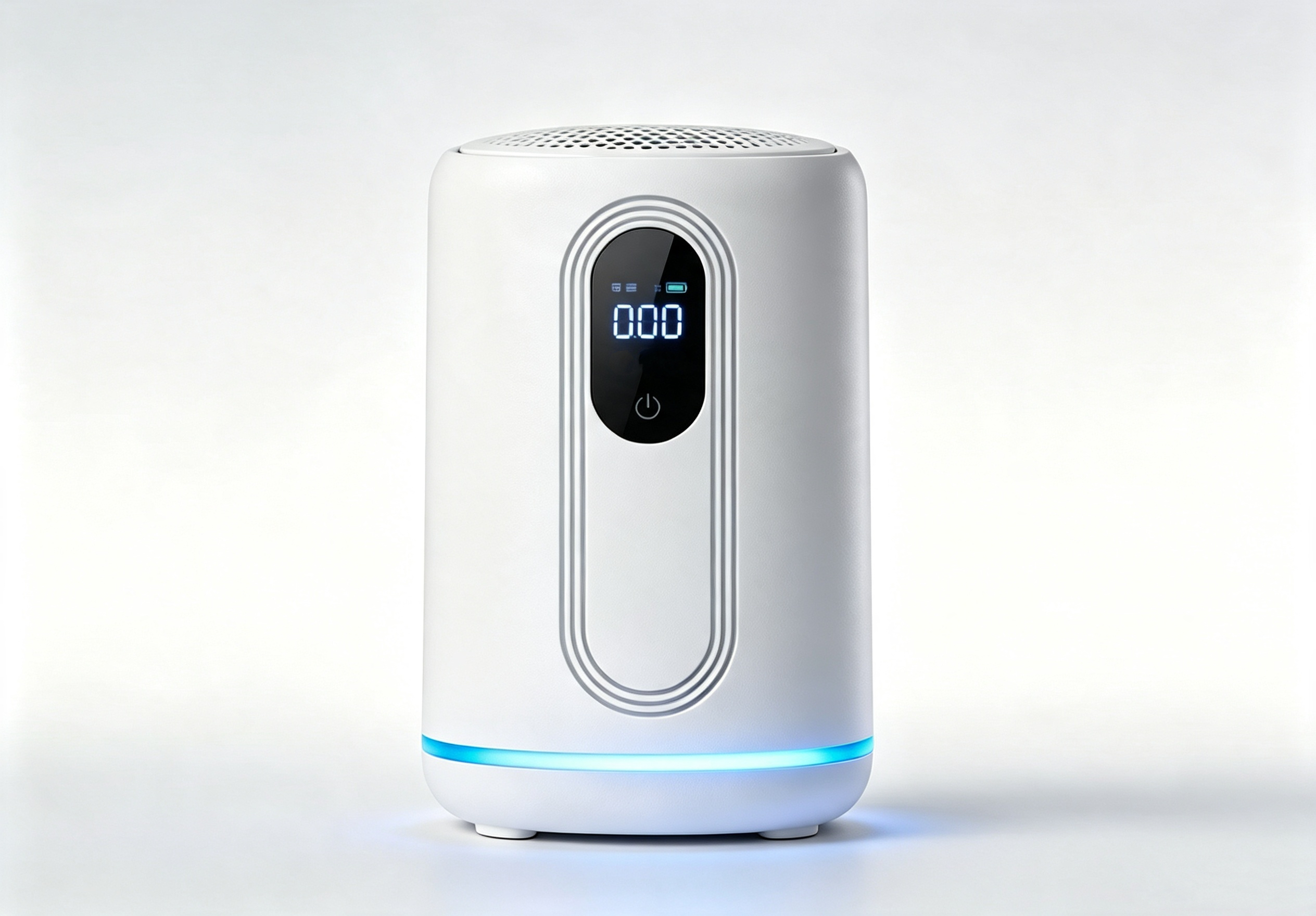
As airborne allergens such as pollen, dust mites, and mold spores increasingly affect everyday life, traditional monitoring devices still suffer from bulky hardware, high cost, slow response, and disconnected data. We developed a portable multi-source airborne allergen monitor to overcome the pain points of conventional monitoring equipment, including large size, high cost, and slow response. Built around the demands of households, outdoor activities, and professional institutions, it delivers accurate, real-time, and convenient allergen monitoring.
The system is optimized for daily use based on fluorescence detection and visual recognition pathways

Based on UV-induced fluorescence detection, the system uses dual-band light sources and multi-channel sensing to accurately distinguish pollen, dust mites, mold spores, and other allergens. It efficiently separates biological and non-biological particles with precision rivaling professional laboratories.

Powered by advanced lensless on-chip microscopy and computational reconstruction algorithms, the system captures high-resolution allergen particle images without bulky optical lenses. This enables precise morphological identification of pollen, dust mites, and mold spores in an ultra-compact form factor.

Abandoning the bulky structure of conventional devices, the product highly integrates core components into a compact body. The whole unit weighs only 0.5 kg, about the size of a 350 ml bottle of mineral water. It is easy to carry, operates quickly under a wide range of temperatures and humidity, and requires no professional installation or calibration.
Covers 0.5-50um particles and supports detection of pollen, dust mites, mold spores, and other common airborne allergens.
Broad-range sampling flow technology delivers results within 3 minutes, detects concentrations as low as 5 particles per cubic meter, and supports 5-level allergy risk alerts.
Operates in 10°C-50°C and 0%-100% humidity environments, providing stable all-day performance across homes, outdoor settings, vehicles, and HVAC spaces.
Built-in lithium battery and fast charging support daily use with no endurance pressure in outdoor scenarios.
A high-definition screen plus app-based remote viewing make the device easy for both elderly users and children.
WiFi/4G/5G dual-mode data transmission with multi-protocol compatibility, cloud synchronization, automatic calibration, and no professional maintenance required.
| Model | Positioning | Connectivity | Display Output | Power | Structure | Operating Environment | Use Cases |
|---|---|---|---|---|---|---|---|
| AllerMonitor-H | Home Edition | WiFi | External display (level indication + corresponding color) | Battery powered | 200 ml body, non-waterproof | Temperature: 0°C to 40°C; Humidity: 20% to 80% RH (non-condensing) | Homes, bedrooms, offices, and other indoor scenarios |
| AllerMonitor-O | Outdoor Edition | 4G / 5G + HDMI | Screen + HDMI output | Battery + solar self-charging | 300 ml body, waterproof design | Temperature: -10°C to 50°C; Humidity: 0% to 100% RH | Outdoor camping, parks, fields, meteorological monitoring stations, and other outdoor scenarios |
| AllerMonitor-S | Sensor Edition | Standard communication interface | No built-in display (supports external terminals) | Battery (optional) | Board-level mode, modular design | Temperature: -10°C to 50°C; Humidity: 0% to 100% RH (non-condensing) | Research integration, industrial equipment integration, industrial environmental monitoring, and custom monitoring system deployment |
Real-time monitoring in bedrooms, living rooms, and children's rooms to identify pollen, dust mite, and other allergy risks in advance.
Supports outdoor activities, driving, and short stays with rapid alerts for high-allergen environments.
Provides accurate detection and stable data support for laboratories, sampling points, and professional institutions.
Suitable for hospital waiting areas, nursing homes, schools, and similar places to protect the respiratory health of sensitive groups.